

I bought the Cascade Mountain Tech trekking poles in early May, mostly because my left knee, which has been cranky since a college volleyball injury, made the first real climb of the season feel like a mistake. I am 54, I hike the North Cascades and the Chuckanut trails near Bellingham almost every week, and I had spent years telling myself poles were for people who needed them. By the end of that first afternoon, I was the person who needed them.
What follows is not a first-impression review. I have used these poles on roughly forty hikes since May, on muddy Chuckanut climbs, loose scree in the Cascades, a rainy week on the Olympic coast, and one very long day on a trail I will not name again. They have been dropped, jammed into gravel, left in a hot car, and soaked through a week of coastal rain. Here is what that much use actually does to a pair of poles, and whether you should spend your money on them.
The Quick Verdict
The Cascade Mountain Tech trekking poles are the best value in hiking poles I have tested in years: light, comfortable cork grips, and a twist lock that has held firm through a full season of abuse. They are not the stiffest or most refined pole on the market, and the stock baskets are mediocre in mud, but at this price they beat poles that cost twice as much.
Amazon Check Today's Price →A full season of hiking later, these are still the poles I grab first
I have put roughly forty hikes on the Cascade Mountain Tech trekking poles, and they have held up better than poles I paid twice as much for. If you want a light, comfortable pair that will not fall apart in a season, check the current price on Amazon.
Amazon Check Today's Price on Amazon →How I've Used It
The poles arrived in three sections each, with cork grips, a twist lock at each joint, and a small tip kit that includes rubber feet and spare carbide tips. I am not a gear reviewer by trade. I am a retired middle-school science teacher who hikes a lot, and I tested these the way most people actually use gear: I packed them, I forgot to maintain them, and I did not read the manual until the second month.
My typical week is two or three day hikes of six to ten miles, usually alone, and a longer weekend hike with my sister Jen when she can get away. That means these poles have seen a lot of elevation gain and loss. The downhill is where my knee complains, and the poles have been the difference between a comfortable ten-mile day and a limping six-mile day. I have also carried them on a few overnight trips, where they earned their keep around camp as well as on the trail.
The first real test came about ten days after I bought them. Jen and I drove up to the trailhead in my Subaru Outback on a Saturday morning and did the full Maple Falls loop, eleven miles with about 2,300 feet of gain. I set the poles once at the start, using the old rule that the grip should sit at the height where my elbow bends to a right angle when the tip is on the ground, and I did not touch the locks again until we were back at the car. That is the whole job of a twist lock, in my opinion: set it, forget it, and trust it on the way down. The descent was the part I was watching. My left knee was talking to me by mile three, and with the poles planted ahead of me on every step, I made it down without the limp I used to accept as normal. I told Jen at the bottom that I should have bought these years ago.
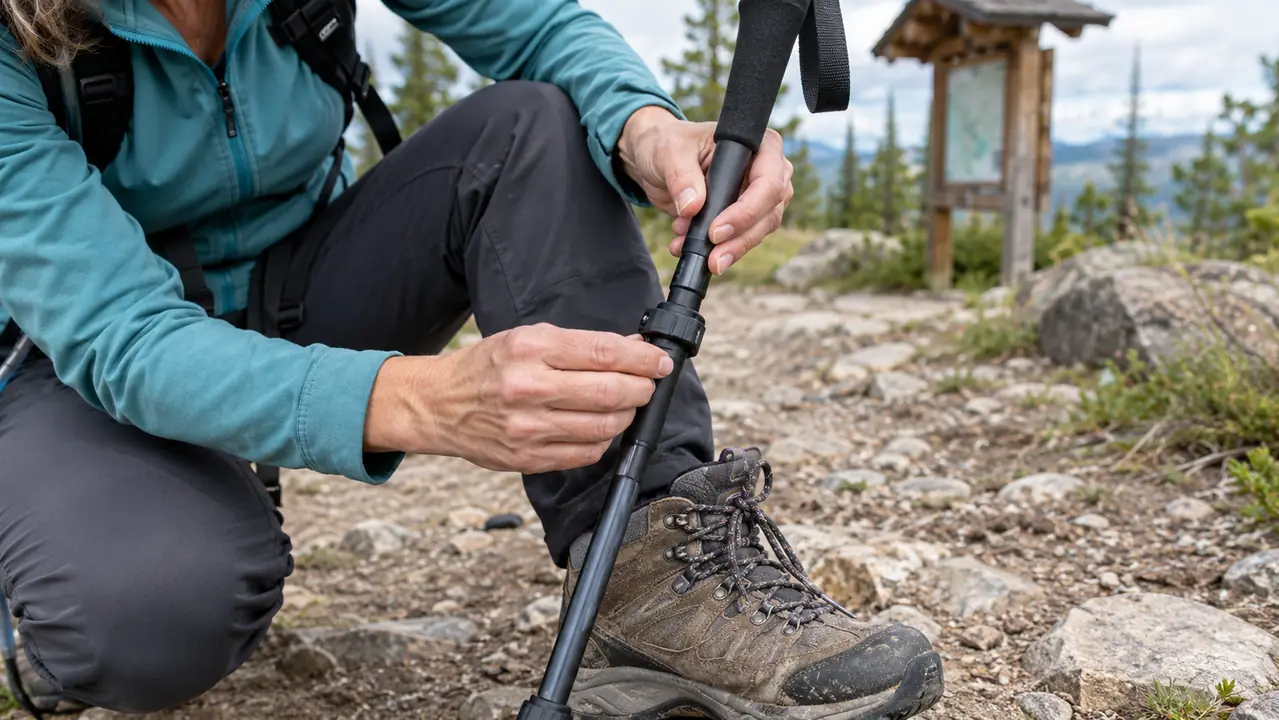
The twist locks are the part I was most suspicious of. I have owned twist-lock poles that slipped after a few hikes, and I expected to be tightening these constantly. In practice, I have adjusted them twice all season, both times after lending the poles to Jen, who is taller than me and turned the sections to her height. Once set, they have stayed set, even on a muddy descent where I was putting a lot of weight on them.
What Makes the Cascade Mountain Tech Poles Different
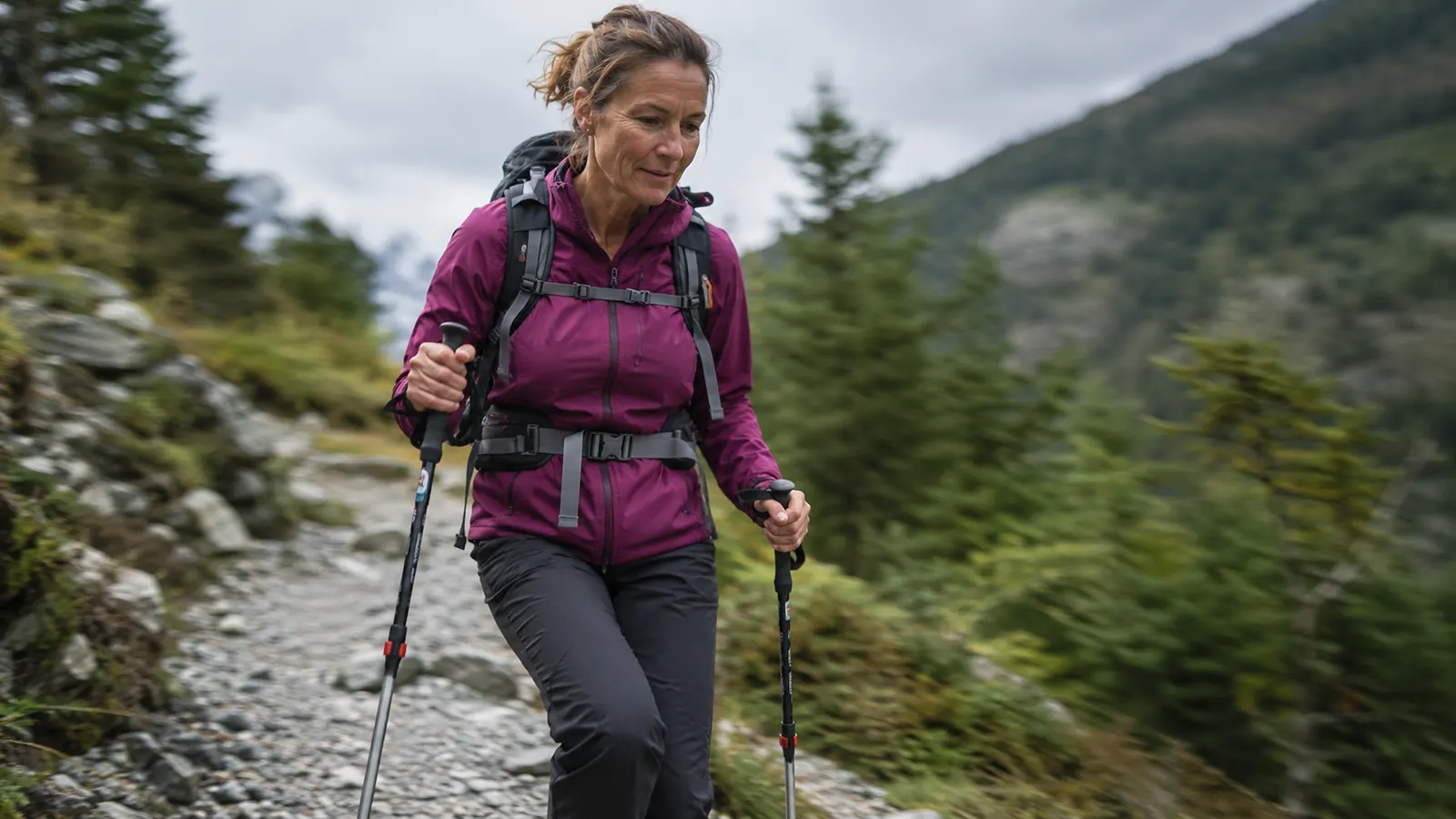
The first thing you notice is the weight. The Cascade Mountain Tech poles are light enough that I stopped noticing them in my hand after about ten minutes, which is exactly what you want. Aluminum poles can feel like plumbing pipe, but these are aircraft-grade aluminum and the sections are thin enough to stay light without bending. I have caught a tip between rocks more than once and expected to hear something crack. Nothing has.
The cork grips are the other standout. Cork gets warmer than rubber in the cold, cooler in the heat, and it absorbs sweat instead of letting your hand slide around. On a long climb in July, my hands were wet for hours and I never felt the grip slip. The extended grip below the main handle is a detail I did not think I would use, and now I use it constantly on steep sections where I choke up on the pole for more control.
The extended grip is a straight section of shaft below the cork, long enough for my whole hand, and I use it more than the main grip on steep switchbacks. When the trail tilts up hard, I slide my hand down, shorten my stride, and plant the pole like a walking stick. It sounds like a small thing, but it has saved me a lot of wasted motion on climbs where the angle changes every few minutes. Jen, who is taller than me, uses the extended grip on every descent because it lets her lower her center of gravity without collapsing the pole to a shorter length. I tried a pair of poles with foam grips years ago, and the foam went slick the first time it got wet. The cork on these has never done that, even on a July day when I hiked through a rain shower and my hands were wet for two hours.
The straps are worth a mention too. They are wide enough not to cut into your hand, and they adjust easily with one hand. A good strap matters more than people think: when you push down on a pole, the strap transfers some of the load from your wrist to your whole arm, which is the difference between tired forearms at mile two and fresh forearms at mile eight.
How They Hold Up Over Months of Use
I am going to be honest about the wear because that is the part of a review that usually gets skipped. After about forty hikes, the cork grips have darkened and compressed slightly where my thumbs rest, but there are no cracks and no chunks missing. The twist locks still bite firmly. The carbide tips have worn down maybe a quarter of their length, which is normal for a season of rocky trails, and the kit includes replacements.
The stock baskets are the weakest part of the package. They are small and they clog in mud. On a wet Chuckanut trail in November, I stopped twice to clear packed mud out of the basket with a stick. I eventually bought a set of larger aftermarket baskets for winter mud and snow, and that fixed the problem. The poles themselves were never the issue, but if you hike a lot of soft ground, budget for better baskets.
The one time I thought I had broken them was in late October. I was coming down a wet Chuckanut trail after a 7.2-mile loop, hit a root wrong, and planted the left pole at a bad angle. The tip caught between two rocks and the shaft flexed hard before I got my weight off it. I stopped and checked the whole length, expecting a bend or a crack. There was nothing, not even a new scratch where the rocks had grabbed it. I have also used a pole as a tent stake in a pinch, on a September overnight when a gust came up while I was setting up camp. It is not what the pole is for, and I would not make a habit of it, but it held the corner down until I could hammer in the real stake.
The paint on the shafts has scuffed where the sections rub together, which is cosmetic and does not affect function. The wrist straps have not stretched. The rubber feet from the tip kit have held up fine for pavement walks, though I stopped using them on trails after one attempt. I tried them on a muddy Chuckanut climb, thinking they would add grip on soft ground. They did the opposite. The rubber slid where the carbide tip would have bitten in. They are for sidewalks and boardwalks, and now they live in the door pocket of my Subaru Outback for the walk from the trailhead to the coffee shop. There is no wobble in the joints, which is the failure mode I have seen in cheaper poles: the sections get loose, the pole flexes sideways, and suddenly you are not sure the thing is going to hold you on a descent. These are still as solid as the day I bought them.
After forty hikes, the twist locks still hold firm, the cork grips have no cracks, and I have never once felt the pole flex sideways under my weight.
The Tradeoffs Nobody Mentions
There are real tradeoffs, and I would not be doing my job if I did not name them. The first is the twist lock itself. It is simple and it has held, but it is slower to adjust than a lever lock. If you are constantly changing pole length, which I do on steep terrain, you will spend more time fiddling than you would with a flip-lock pole. I have learned to set my poles at the start of a climb and leave them, but it took me a while to stop obsessing over the perfect length.
I borrowed a friend's flip-lock poles for a weekend to see what I was missing. The lever lock was faster, no question, maybe two seconds per adjustment instead of five. But the lever mechanism pinched my palm once when I closed it, and the locking collar added noticeable weight at the top of the pole. I went back to the twist locks by Sunday afternoon. My standard setup now is the upper section fully extended and the lower section turned out until my elbow sits at a right angle, and I leave it there for the whole hike.
The second is stiffness. These are not the stiffest poles I have used. A carbon pole from a brand that charges three times as much will transmit less vibration and feel more precise on hard pack. The Cascade Mountain Tech poles have a little flex, which is actually comfortable on long downhills, but if you are the kind of hiker who wants maximum power transfer on every stride, you will feel the difference.
The third is the locking mechanism on the lower section. It is the same twist lock as the upper joint, and it has never slipped on me, but I have read enough reports from other owners to know that twist locks can be finicky if you overtighten them. I learned that lesson myself the first time I adjusted the poles. I cranked the collar hard, the way you would tighten a jar lid, and it did not strip, but the joint was stiff for the rest of the day. The right amount is just enough to stop the sliding, then a few degrees more. I have not stripped a thread in six months of use, but I can see exactly how it would happen, and I treat the collars gently when I adjust them.
What I Liked
- Light for aluminum poles, easy to swing all day
- Cork grips stay comfortable in heat and cold
- Twist locks have held firm through a full season
- Extended grip is genuinely useful on steep climbs
- Tip kit includes replacements and rubber feet
- Price is hard to beat for the quality
Where It Falls Short
- Stock baskets are small and clog in mud
- Twist locks are slower to adjust than lever locks
- Not the stiffest pole for aggressive hikers
- Paint scuffs where sections rub together
Who This Is For
These poles are for the day hiker and weekend backpacker who wants one pair that does everything well without a big investment. If you hike a few times a month, if you are dealing with knee or back pain on descents, if you have been borrowing poles and finally want your own, the Cascade Mountain Tech poles are the pair I would hand you. They are light enough for long days, tough enough for rocky trails, and comfortable enough that you will forget you are carrying them.
They are also a great choice for someone who is not sure poles are for them. At this price, you can find out without feeling like you wasted money. I have loaned mine to three friends this season, and two of them bought their own pair within a month. The third, my sister Jen, is still borrowing mine, which tells you something about how well they work.
Who Should Skip It
Skip these if you are a hardcore ultralight hiker who counts every ounce. These are light for aluminum poles, but a carbon pole will save you several ounces per pole, and if you are doing twenty-mile days, that adds up. Skip them too if you want the absolute stiffest, most precise pole for aggressive downhill running or technical scrambling. Those hikers should look at a premium carbon pole with lever locks.
And if you hike mostly in deep mud or snow, factor the cost of better baskets into your decision. The poles themselves are excellent, but the stock baskets will frustrate you in soft ground. That is a small fix, but it is a real one, and I would rather tell you now than have you discover it on a wet trail.
The poles I will be carrying again next season
After months of real trail use, the Cascade Mountain Tech trekking poles are still going strong. If you want a light, honest pair of poles that will not break the bank, check the current price on Amazon.
Amazon Check Today's Price on Amazon →