
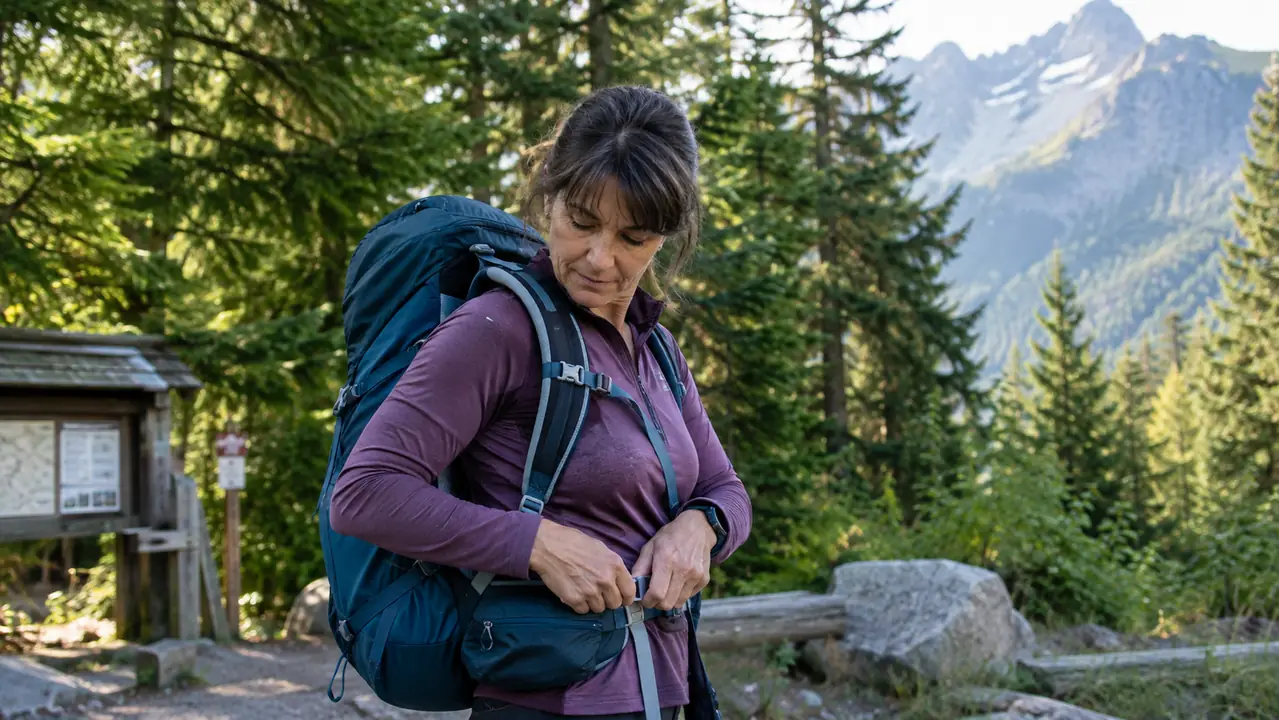
I bought the TETON Sports Scout 55L in March, about a week before my first overnight trip of the season. I had just turned fifty-four, my left knee was reminding me daily about a college volleyball injury from thirty years ago, and my old pack, a cheap frameless thing I had owned since grad school, made every climb feel like a punishment. I needed something that would put weight on my hips instead of my shoulders. I needed it to fit a person who is five-four, not the six-foot mannequin the big-box stores seem to stock for. And I needed it to survive the North Cascades, where the weather changes faster than my sister Jen can change her mind about which trail we are doing.
This is not a review written after one weekend. It is a review written after months of real trail use: weekday solo hikes on the Chuckanut trails, three overnight trips in the North Cascades, one very wet weekend near Baker Lake with Jen, and enough trips to the trailhead in my Subaru Outback that the TETON Sports Scout has its own permanent spot in the back. I kept notes because I used to teach middle school science and I cannot help myself. Here is what I learned.
The Quick Verdict
A well-built 55-liter pack that transfers weight to your hips better than packs twice the price. Not the lightest, not the most refined, but honest gear that has held up through a full season of Pacific Northwest weather.
Amazon Check Today's Price →The pack I reach for every single trip
If you want a 55-liter pack that carries a weekend load without wrecking your shoulders, this is the one I have used all season. Check today's price on Amazon to see if it fits your budget.
Amazon Check Today's Price on Amazon →How I've Used It
I have put roughly thirty trail miles a month on this pack since March, which is not a huge number by thru-hiker standards but is a real number for a retired teacher who hikes three or four times a week. Most of those miles are on the Chuckanut trails close to home, where the climbs are short and punchy and the roots are relentless. The rest are from longer trips: a two-nighter on the Cascade Pass area, a weekend along the Skagit, and the Baker Lake trip with Jen where it rained from Friday afternoon to Sunday morning.
I carry between twenty-two and thirty pounds depending on the trip. My base weight is around fifteen pounds, and then I add food, water, and the extra layers that Washington weather demands. I use trekking poles on every descent because of my knee, which means I care a lot about how a pack rides when you are not using your arms to steady yourself. A pack that shifts sideways on a downhill is a pack that makes my knee hurt by mile four.
I also used it as a carry-on for a flight to see my sister in early summer, which is not what it is designed for, but it taught me that the pack compresses down to something that fits in an overhead bin if you do not overstuff it. That is not a selling point I would rely on, but it is a nice surprise.
One more thing about how I use it: I keep the rain cover in its pocket even on sunny days. It weighs almost nothing, and there have been two trips this season where a clear morning turned into an afternoon squall before I reached the treeline. Having the cover already attached to the pack means I can stop, pull it out, and be moving again in under a minute.
The Frame and Hip Belt: Why Load Transfer Matters
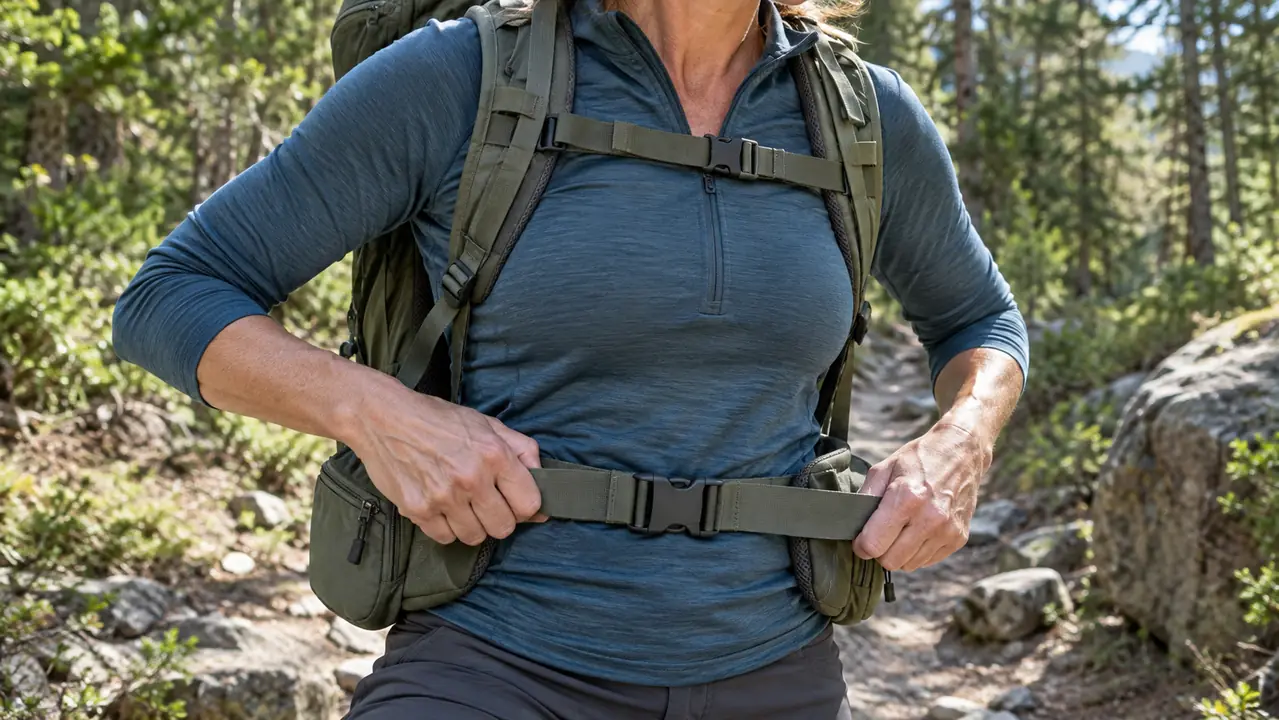
Here is the part I care about most, and the part most reviews skip. The Scout 55L has an internal frame with a single aluminum stay, and the frame is what turns a heavy load from a shoulder problem into a hip problem. When the hip belt is cinched down and the load lifters are snugged, most of the weight sits on my hips. My shoulders carry maybe a quarter of it. For someone with an old knee injury, that matters twice: first because a stable load means I am not fighting the pack on every step, and second because when my shoulders are free, I can actually use my trekking poles to take pressure off the knee on descents.
The hip belt is padded and stiff enough to hold its shape, with a buckle that I can reach and adjust one-handed while walking. That might sound like a small thing, but try adjusting a floppy belt on a windy ridge sometime. The load lifters, the little straps at the top of the shoulder straps, are the detail most budget packs get wrong. On this pack they actually do something. I have owned packs where those straps were decorative. Here, snugging them pulls the top of the pack into my back and stops the whole thing from leaning backward on steep climbs.
The frame does have a limit. I loaded the pack to about thirty-five pounds once, to haul extra water for a dry camp, and at that weight the suspension started to feel less planted. It was fine, but I could feel the frame working harder. If you regularly carry more than thirty-five pounds, you want a pack with a stiffer frame and a heavier-duty belt. For a weekend load, this is more than enough.
Pockets, Access, and the Small Details
The Scout 55L has a top-loading main compartment with a drawstring closure under the lid, plus a sleeping bag compartment at the bottom with its own zipper. That bottom zipper is the feature I use most. I can pull out my sleep clothes or my camp shoes without unpacking everything on top of them. It also has a big front pocket that runs almost the full height of the pack, which is where I keep my rain shell and my map. I like that pocket because it is accessible without opening the main compartment, and it is deep enough that things do not fall out when I unzip it.
There are two side pockets made of stretch mesh. They fit a one-liter bottle each, and they held up fine through the season, which I did not expect. Mesh pockets are usually the first thing to tear on a budget pack. Mine have stretched a little but nothing has ripped. There is also a small pocket on the hip belt, big enough for a phone or a snack, and a small pocket inside the lid for keys and a headlamp. The included rain cover lives in a pocket at the base of the pack, and it covers the whole pack, not just the top half. After the Baker Lake trip, I can tell you it works.
The one detail I would change is the lid. It is a simple flap, not a full zippered top, which means you have to be careful when you open the pack that small items near the top do not roll out. I learned this the hard way with a tube of sunscreen. It is a minor complaint, and it is the kind of thing you adapt to in a week, but it is worth knowing before you buy.
How It Handled a Full Season of Weather
I am going to be honest about the fabric, because this is where the price shows. The Scout 55L is not made of the fancy ripstop nylon you find on packs that cost three times as much. The fabric is a plain woven polyester that feels a little stiff when new and softens up over time. It has picked up a few snags from tree branches on overgrown trails, and the bottom has some scuffs from being set down on rocky ground. Nothing has torn, nothing has leaked, and the zippers all still run smooth. But if you are the kind of person who wants a pack to look new after two years, this is not that pack.
The rain cover is the real story. It is sewn into a small pocket at the bottom, so it is always with the pack, which means I actually use it. On the Baker Lake trip it rained hard for two days straight and everything inside stayed dry, including my sleeping bag, which was in the bottom compartment. The cover is a little loose on the pack, so it flaps in wind, but it does its job. I also like that I can spot the pack from twenty feet away when I set it down in the woods.
The shoulder straps and back panel are padded with a mesh that breathes reasonably well. On a hot August climb I still ended up with a sweaty back, because everyone does, but the pack did not make it worse. The mesh has not worn through or started peeling, which is another thing I have seen happen on cheaper packs within a single season.
The Tradeoffs Nobody Mentions
Every review of this pack mentions the price, and the price is genuinely good. But here are the tradeoffs that the five-star reviews tend to skip. First, the pack itself is not light. It weighs about four and a half pounds empty, which is on the heavy side for a 55-liter pack. For weekend trips where I am carrying twenty-five pounds, that is a small fraction of the total, and I do not notice it. For someone counting every ounce on a longer trip, a lighter pack is worth the extra money.
Second, the suspension is good, not great. The frame handles a weekend load beautifully, but it does not have the fine-tuned adjustability of a pack from a brand that costs considerably more. You get a fixed torso length in two sizes, not a fully adjustable harness. I am five-four and the small size fits me well, but if you are between sizes, you should measure your torso before you order and not guess.
Third, the fabric is loud. By that I mean it makes a rustling sound when you walk, because it is a stiffer weave than the soft-touch fabrics on expensive packs. You get used to it, and it does not bother me, but it surprised me on the first few hikes. That is the TETON Sports formula, and I think it is the right trade to make. None of these tradeoffs changed my opinion of the pack. They are just the honest reasons it costs what it costs.
Alternatives I Considered
I looked hard at the Osprey Rook 50L before I bought the Scout. The Rook is a more refined pack: softer fabric, a more adjustable harness, and the kind of warranty that Osprey is famous for. It also costs meaningfully more. For my use, a weekend load in the North Cascades, the Scout does everything I need at a price that left me room to buy good boots and a proper sleeping pad. I have no regrets, and I have told Jen the same thing.
I also considered a much lighter frameless pack for day hikes, but I wanted one pack that could do both day trips and overnights, and the Scout does that better than any frameless pack I have tried. A frameless pack is great until you put twenty-five pounds in it, and then it becomes a shoulder-hurting tube. The frame in the Scout is the whole reason I can carry a weekend load without my knee complaining.
What I Liked
- Internal frame with a real hip belt that transfers weight where it belongs
- Included rain cover that actually covers the whole pack and lives in its own pocket
- Bottom sleeping bag compartment with a zipper, so you can reach gear without unpacking
- Comfortable for a five-four hiker when you buy the right size
- Price leaves room in the budget for the rest of your kit
Where It Falls Short
- Pack itself is on the heavy side at about four and a half pounds empty
- Fabric snags and scuffs more easily than pricier packs
- Lid is a simple flap, so small items can roll out when you open it
- Suspension has a limit around thirty-five pounds
After three overnights and a two-day downpour, everything inside stayed dry and my shoulders still worked the next morning. That is the whole job.
Who This Is For
The TETON Sports Scout 55L is for the weekend backpacker who wants one pack that does everything: day hikes with a heavy lunch and a puffy jacket, overnight trips with a tent and a sleeping bag, the occasional carry-on flight. It is for people who care more about where the weight sits than about the label on the strap. It is for people like me, who have a body part that complains, and who learned that a pack that rides on your hips instead of your shoulders is worth more than any fancy fabric.
Who Should Skip It
Skip this pack if you are a thru-hiker counting ounces, because four and a half pounds is a lot of pack to carry for a thousand miles. Skip it if you regularly carry more than thirty-five pounds, because the suspension will let you know. And skip it if you want a pack that still looks new after a season of hard use, because the fabric will show its miles. None of those are failures of this pack. They are just reasons it is not the pack for you, and it is better to find that out before you buy than after.
Ready to see if it fits your back?
The Scout 55L has been my go-to pack all season. If you want the same load-carrying comfort on a weekend budget, check today's price on Amazon.
Amazon Check Today's Price on Amazon →